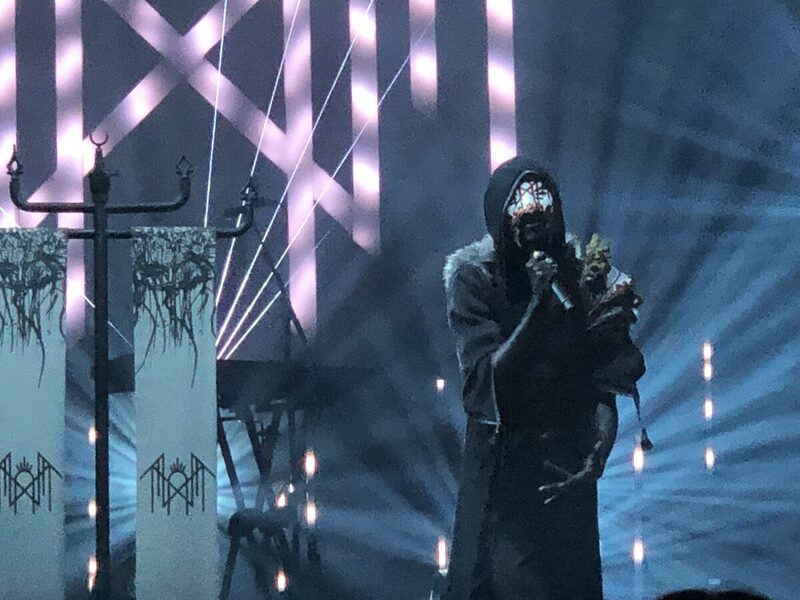
What Does Leo Faulkner Actually Look Like?
If you’re here, you’ve probably fallen deep enough into Sleep Token’s world that the question won’t leave you alone: what does Vessel actually look like under the mask? You’re far from alone. It’s one of the most searched questions in the Sleep Token community, and it has a surprisingly straightforward answer.
Leo George Faulkner, born December 22, 1993, in Bristol, England, performed openly and without any face covering for years before Sleep Token existed. Based on widely circulated photos from his time in Blacklit Canopy and his solo project Dusk, Faulkner has a slim build and angular facial features. He has dark hair, often worn at medium length during the Blacklit Canopy years, and a generally understated personal style that contrasted with the more theatrical presentation he would later adopt. He’s of average-to-tall height, something visible in full-body stage shots alongside his Blacklit Canopy bandmate Gemma Matthews.
None of this is leaked information or the product of invasive investigation. These are photos from a period when Faulkner was a working musician performing under his own name, in public venues, often photographed by event photographers and press outlets. The images are part of the public record of his earlier career.
That said, there’s an important distinction to draw here at the outset. Understanding what Faulkner looks like and respecting the very deliberate choice he has made to perform anonymously as Vessel are not mutually exclusive. This article aims to document the visual history that is already publicly available, trace the evolution of Sleep Token’s iconic mask designs, and do so without crossing lines that the artist himself has clearly drawn.
The Blacklit Canopy Era: Before the Mask
Before Sleep Token, before the masks and the worship and the rituals, Leo Faulkner was simply a young musician making atmospheric, emotionally dense music in Bristol’s indie scene. His most documented project from this period is the duo, a duo he formed with vocalist and multi-instrumentalist Gemma Matthews.
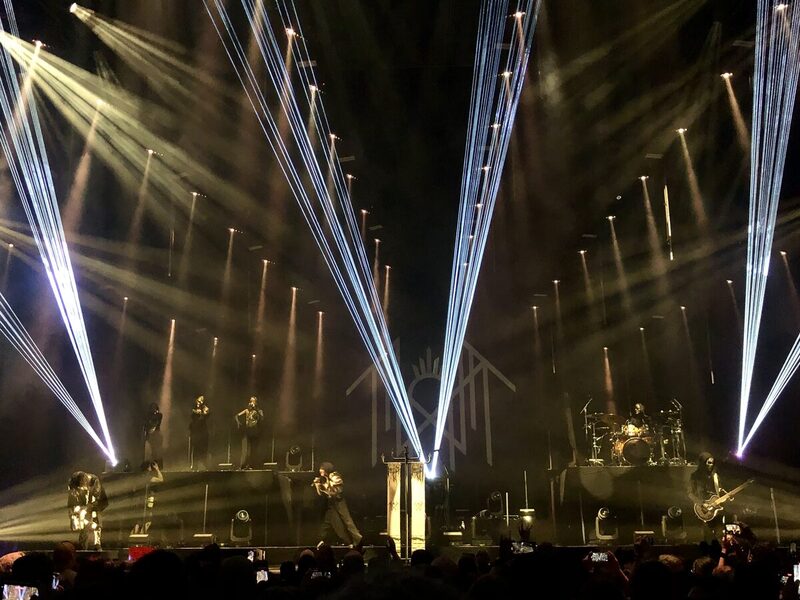
the project produced haunting, layered music that drew on shoegaze, ambient, and post-rock textures. The project was active in the early-to-mid 2010s, and during this time, Faulkner appeared at gigs, in promotional photos, and on social media without any attempt to conceal his identity. He was, by all accounts, an ordinary emerging artist building a local following.
The photos from this era are the most widely circulated “unmasked” images of Faulkner. They typically show a young man in his early twenties with a quiet intensity about him – the kind of person you might walk past without a second glance, which is perhaps part of what makes the transformation into Vessel so striking. There’s nothing visually dramatic about pre-Sleep Token Faulkner. He dressed simply, didn’t cultivate a flashy stage persona, and let the music do the work.
His solo project, Dusk, operated in a similar vein. The music leaned toward ambient and electronic territory, and though less documentation exists from Dusk compared to the pre-Sleep Token project, what does survive reinforces the same picture: a thoughtful, somewhat reserved musician who hadn’t yet developed the masked, ritualistic stage identity that would come to define his career.
What makes the duo-era photos so important to the Sleep Token story is the contrast they provide. When you see photos of a mild-mannered young man from the city and then watch Vessel stalk a stage in elaborate face coverings, channelling something that feels genuinely otherworldly, the sheer scale of the artistic transformation becomes visceral. The mask isn’t just hiding a face. It’s enabling a completely different mode of performance.
For more on Faulkner’s musical journey through this period, see our full the project page.
Early Sleep Token: The First Masks
Sleep Token emerged in late 2016 with an air of deliberate mystery. From the very first appearance, the project’s frontman – credited only as Vessel – wore a mask. But the early masks were far removed from the elaborate designs fans know today.
In the 2016-2018 period, Vessel’s face coverings were relatively simple. Early iterations involved what appeared to be a basic white or off-white mask with minimal detailing, sometimes paired with dark, loose-fitting clothing and bandages or wrappings around the hands and arms. The overall effect was lo-fi and unsettling in a raw, unpolished way. It felt less like a carefully art-directed visual identity and more like someone literally obscuring themselves, stripping away personhood to become a conduit for something else.
At this stage, Sleep Token was playing small venues, and the visual production was minimal. There were no elaborate stage setups, no complex lighting rigs. The mask existed almost in isolation as the sole visual statement, which in some ways gave it even more power. In grainy phone footage from these early shows, the pale mask floating in a dark room, attached to a voice delivering genuinely extraordinary vocal performances, created something deeply uncanny.
For those trying to reconcile the ambient duo-era photos with these early Vessel appearances, the physical build and movement patterns are consistent, but the mask and the deliberate anonymity created a genuinely different presence. Even in these early days, it was clear that the concealment wasn’t a gimmick – it was foundational to how this project communicated.
Sundowning and This Place Will Become Your Tomb Era
With the release of Sundowning in 2019 and This Place Will Become Your Tomb in 2021, Sleep Token’s visual identity began to mature significantly. The masks evolved from those early, almost improvised-looking coverings into something more considered and aesthetically coherent.
During the Sundowning era, Vessel’s mask took on a more defined shape. It retained the pale colour palette but began to incorporate more sculptural elements – smoother contours, a more deliberate fit, and an increasingly inhuman quality. The mask was starting to look less like something a person was wearing and more like a face in its own right. Around this time, the rest of the band – II, III, and IV – also adopted more consistent masked identities, and the stage production grew to match the ambition of the music.
By the This Place Will Become Your Tomb cycle, the transformation was accelerating. Stage design became more elaborate, incorporating specific lighting palettes and visual motifs that tied into the album’s themes. Vessel’s mask continued to evolve – subtly, but noticeably to attentive fans. The coverings around the body became more intentional, the silhouette more distinctive. Sleep Token was no longer a mysterious small-venue project. They were filling larger rooms, and the visual presentation scaled accordingly.
What’s particularly interesting about this period is how little of Faulkner’s actual physical appearance was visible. The masks were covering more. The costumes were more enveloping. Where early shows might have revealed glimpses of jawline or neck, the Tomb era began to seal those gaps. The anonymity was becoming more thorough as the project grew, not less – the opposite of what you might expect from a band gaining mainstream traction.
Take Me Back to Eden: A New Visual Identity
The release of Take Me Back to Eden in 2023 marked the most dramatic visual reinvention in Sleep Token’s history. Everything changed. The mask, the costuming, the stage design, the lighting – all of it was reconceived from the ground up, and the result was something that felt like a genuine evolution rather than a simple refresh.
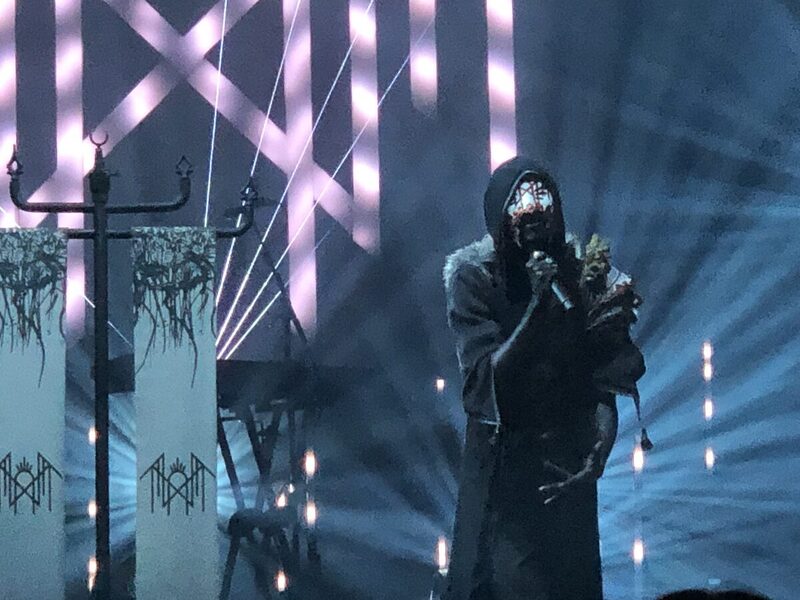
Vessel’s Take Me Back to Eden mask was a striking departure. It moved away from the pale, relatively smooth designs of previous eras toward something more textured, more organic, and more visually complex. The new mask incorporated intricate surface details that evoked natural forms – bark, bone, weathered stone. It felt ancient and ritualistic in a way the earlier masks had only hinted at. The colour palette shifted, incorporating darker and more earthen tones.
The costuming followed suit. Vessel’s stage wardrobe became more elaborate, incorporating flowing fabrics, layered textures, and elements that suggested a figure from some forgotten mythology rather than a contemporary rock frontman. The other band members received similarly upgraded visual identities, creating a more cohesive ensemble aesthetic.
This era also coincided with Sleep Token’s explosion into mainstream consciousness. They were headlining major festivals, selling out arenas, and reaching audiences who had never encountered the project before. The visual reinvention ensured that this larger audience encountered Sleep Token at their most visually striking. For many fans, the Take Me Back to Eden mask is the definitive Vessel look – the one they picture when they think of the band.
The irony, of course, is that this was also the era when more people than ever were searching for photos of what the person behind the mask actually looked like. The more elaborate and compelling the mask became, the more curiosity it generated about the face beneath it.
Watch how Vessel's visual identity evolved in the "Emergence" music video:
Even in Arcadia: The Current Look
With Even in Arcadia arriving in 2025, Sleep Token’s visual evolution continued its forward trajectory. The current era represents the most fully realised version of the project’s visual identity to date.
Vessel’s latest mask design builds on the organic, textured approach introduced during Take Me Back to Eden while pushing into new territory. Without cataloguing every detail – part of the experience is encountering it live – the current mask continues to balance the inhuman with the expressive. It conceals completely, yet somehow Vessel’s performances remain deeply emotive. The mask has become an instrument in its own right, a surface onto which audiences project their own emotional states.
The stage production for this era is the most ambitious yet. Sleep Token’s current live show is a fully immersive experience, with lighting, visual projections, and staging all working in concert with the music and the masked performers to create something that transcends a conventional concert. For fans attending these shows, the question of what Vessel “really” looks like often fades into irrelevance. The mask doesn’t feel like it’s hiding something. It feels like it’s revealing something – a version of artistic expression that a bare human face might actually limit.
For those who attend current shows hoping to catch a glimpse of the face underneath, the modern mask and costume design make this essentially impossible. Every iteration has closed gaps and eliminated sight lines. This is clearly intentional and, as we’ll discuss, worth respecting.
How Sleep Token’s Masks Tell a Story
Taken together, the evolution of Sleep Token’s masks is not just a series of aesthetic upgrades. It’s a narrative in its own right, and understanding it adds depth to the project’s music and mythology.
The earliest masks – raw, simple, almost desperate in their minimalism – reflect a project in its infancy. Sleep Token’s early music was similarly stripped-back: a voice, electronic production, intense emotion, and not much else. The mask matched the music. Both were saying: this is not about a person. This is about something moving through a person.
As the music grew more complex and ambitious, so did the masks. The Sundowning and This Place Will Become Your Tomb eras saw the masks become more refined, more intentional, more clearly designed rather than improvised. This mirrors the musical journey from bedroom project to full-band endeavour with professional production and increasingly sophisticated songwriting.
The Take Me Back to Eden reinvention was the most significant leap, and it’s no coincidence that it accompanied the album many fans consider Sleep Token’s creative peak. The music reached for something mythic and elemental, and the masks followed, becoming objects that looked like they belonged in a temple rather than on a stage.
Now, in the Even in Arcadia era, the masks feel less like costumes and more like the actual faces of these figures. The transformation is complete. What began as a young the area musician putting something over his face to separate himself from his creation has become a fully integrated artistic identity where the mask is not concealing the “real” person but rather revealing the “real” character.
This is worth sitting with if you came to this page purely to see what Leo Faulkner looks like without a mask. The masks are not obstacles to understanding Sleep Token. They are part of the understanding. Each design choice, each evolution, each carefully sealed gap where skin might otherwise show – these are all artistic decisions as deliberate as any lyric or guitar tone.
See the latest visual era in the "Chokehold" video - Vessel's most exposed mask design yet:
Verified Public Appearances
Despite the elaborate measures Sleep Token takes to maintain anonymity during performances and official appearances, there have been instances where Leo Faulkner has been photographed in public without the mask. This is the nature of being a public figure in the age of smartphone cameras – complete anonymity outside of controlled environments is nearly impossible.
The most commonly cited unmasked sightings fall into a few categories:
Airport and travel photos. As Sleep Token has toured more extensively, particularly internationally, members have occasionally been photographed at airports or in transit. These images circulate on social media, typically showing Faulkner in casual clothing, often with a hat or hood but without the Vessel mask. The photos are generally candid and taken at a distance.
Pre-and post-show sightings. Fans waiting outside venues before or after Sleep Token performances have occasionally photographed band members arriving or departing. These sightings are sporadic, and in many cases, the band takes measures to enter and exit discreetly.
Social settings. A small number of photos exist showing Faulkner at music industry events, with friends, or in social settings during the Sleep Token years. These are rare and tend not to circulate as widely as the that project-era images.
It’s worth noting that in the verified public photos that do exist from the Sleep Token era, Faulkner looks much as you’d expect based on the duo images – older, naturally, but recognisably the same person. There’s no dramatic transformation being hidden beneath the mask, no reason the mask “needs” to exist from a vanity perspective. Its purpose is artistic, not cosmetic, which makes it all the more worthy of respect.
A Note on Privacy and Respect
This is the section that matters most, so if you’ve scrolled past everything else, stop here.
There is a meaningful difference between looking at photos from a period when Leo Faulkner performed publicly under his own name and actively trying to unmask someone who has made a clear, sustained, deliberate choice to perform anonymously. the project and Dusk-era photos are part of the public record. Faulkner was a credited, named musician. He appeared in promotional materials. He played public shows. Discussing and showing those images is no different from discussing any musician’s earlier career.
But seeking out, sharing, or shouting a performer’s real name at a show when they have built an entire artistic framework around anonymity is a different act entirely. It’s not investigative journalism. It’s not holding power to account. It’s a person deciding that their curiosity matters more than an artist’s creative vision.
Sleep Token’s anonymity is not a puzzle to be solved. It’s a choice to be respected. The masks are not a challenge issued to fans – figure out who we really are – they’re an invitation: let go of who we are and focus on what we’re creating.
Some practical guidelines for fans:
- the earlier project and Dusk-era photos are fair game to view and discuss. They’re from a public period of an artist’s career.
- Candid photos taken without consent during the Sleep Token era occupy an ethically grey area. They exist, and people will find them, but actively seeking them out or sharing them widely works against the artist’s stated wishes.
- Shouting real names at shows is disrespectful to both the performer and fellow audience members who are trying to engage with the art on its own terms.
- Doxxing, harassing, or following any musician in an attempt to photograph them unmasked is unacceptable under any circumstances.
The fact that you now know what Leo Faulkner looks like doesn’t diminish Sleep Token’s artistry. If anything, it should enhance your appreciation for the commitment involved in building and maintaining such a thorough artistic identity over nearly a decade. The person behind the mask chose to become something else on stage, and that transformation is the art.
For details on Leo Faulkner’s height, eye colour, tattoo questions, and physical features, see: Leo Faulkner Appearance - Tattoos, Height & Features.
Leo Faulkner Unmasked FAQ
What does Leo Faulkner look like without the mask?
Based on widely available photos from his their earlier work and Dusk eras, Leo Faulkner has dark hair, angular features, a slim build, and an understated personal appearance. He performed openly during this period, and these photos remain accessible online. There’s nothing unusual or surprising about his appearance – he looks like an ordinary person, which is partly what makes the Vessel transformation so remarkable as a piece of performance art.
Are the Blacklit Canopy photos really him?
Yes. Leo Faulkner is credited by name in that project’s materials, and the connection between Faulkner and the Sleep Token project has been established through extensive public documentation including vocal analysis, social media histories, and contemporaneous accounts. the pre-Sleep Token project photos show a credited, named musician during a period when he performed openly.
Has Vessel ever been seen without his mask at a Sleep Token show?
Sleep Token takes extensive measures to ensure the band members are masked for all public-facing moments during their performances and official appearances. There are no verified instances of Vessel appearing unmasked on stage or in any official Sleep Token capacity. Occasional candid photos taken outside of performances do exist but are not endorsed or sanctioned by the project.
Why does Vessel wear a mask?
The masks are a core component of Sleep Token’s artistic identity and mythology. The project is framed as a devotional act to an ancient deity called Sleep, and the anonymity of the performers reinforces the idea that Sleep Token is not about individual personalities but about channelling something larger. The masks serve the narrative, create a distinctive visual identity, and allow the music and performance to exist independently of the personal identities of the people creating it.
How many different masks has Vessel worn?
Vessel’s mask has gone through several distinct iterations corresponding roughly to Sleep Token’s album eras. The earliest designs from 2016-2018 were simple and minimalist. The Sundowning and This Place Will Become Your Tomb eras each brought refinements. The Take Me Back to Eden era in 2023 introduced the most dramatic redesign, and the Even in Arcadia era brought further evolution. Within each era, there have also been subtle variations between shows and appearances.
Is it disrespectful to look up what Vessel looks like?
Viewing photos from Leo Faulkner’s pre-Sleep Token career, when he performed publicly under his own name, is not inherently disrespectful. Those are part of the public record. However, actively trying to unmask Sleep Token members during the masked era – through stalking, invasive photography, or shouting real names at performances – works against the artistic vision the project has carefully constructed. Curiosity is natural; how you act on it is what matters.
Do the other Sleep Token members also have known identities?
The identities of Sleep Token’s other members (known as II, III, and IV) have also been the subject of fan investigation, and various names have circulated within the community. However, like Vessel, the other members perform exclusively in masked anonymity, and the same principles of respect apply. This article focuses specifically on Leo Faulkner because his pre-Sleep Token career is the most extensively documented.