
Gold bars representing luxury wealth and Sleep Token music industry success

Leo Faulkner Net Worth 2026 — Sleep Token Earnings Breakdown

Quick Answer: Leo Faulkner’s Estimated Net Worth

Leo Faulkner’s net worth is estimated to fall between $1 million and $2 million as of early 2026. Some online sources place the figure as low as $500,000, while others speculate higher. The honest answer is that no one outside Faulkner’s inner circle knows the precise number, and anyone who claims otherwise is guessing.

What we can do is work through the publicly observable revenue streams that flow from Sleep Token – streaming royalties, touring income, merchandise sales, and songwriting royalties – and arrive at a reasonable range based on industry-standard rates and publicly available data. That is what this article sets out to do.

A few things worth stating upfront. First, Sleep Token is a band, not a solo act. Revenue is shared among members, management, agents, labels, and other parties. Even though Faulkner is the primary songwriter and creative architect, his personal take-home is a fraction of the band’s gross income. Second, these figures are estimates informed by how the music industry generally works, not leaked financial documents. Third, Faulkner’s earnings have grown dramatically over a short period. The difference between Sleep Token’s financial position in 2019 and 2026 is enormous, and much of the serious money has arrived only in the past two to three years.

With those caveats established, here is the most thorough breakdown available.

How Sleep Token Makes Money

Sleep Token generates revenue through four primary channels, each of which has scaled significantly since the Take Me Back to Eden breakthrough in 2023:

  • Streaming royalties from platforms like Spotify, Apple Music, YouTube, Amazon Music, and others
  • Touring and live performance income from ticket sales, guarantees, and festival fees
  • Merchandise sales both at shows and through online stores
  • Songwriting and publishing royalties registered through ASCAP, covering radio play, sync licensing, and mechanical royalties

There are also secondary income sources – physical album sales, vinyl pressings, potential brand partnerships – but the four categories above account for the vast majority of what flows in. Let’s take each one apart.

Streaming Revenue

This is the most visible and quantifiable piece of the puzzle, because streaming numbers are largely public.
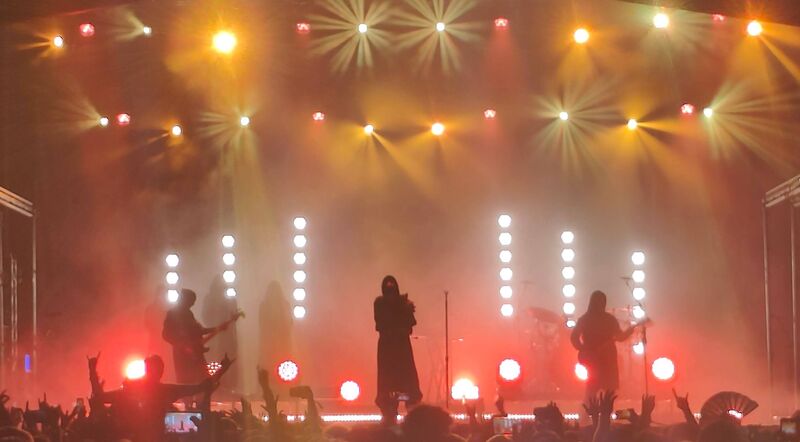
Sleep Token at Aftershock Festival 2023
Sleep Token at Aftershock Festival, 2023. Photo: Wunderbrot, CC BY-SA 4.0.

The Raw Numbers

Sleep Token’s catalogue has exceeded 3 billion total streams across platforms as of early 2026. To put that in context: three billion streams is an extraordinary figure for any act in the rock and metal space. It places Sleep Token in a streaming tier historically occupied by bands like Imagine Dragons or Twenty One Pilots rather than their genre peers.

The individual track numbers are staggering:

SongApproximate Spotify Streams
“The Summoning”500 million+
“Take Me Back to Eden”300 million+
“Chokehold”250 million+

Those are three songs alone accounting for over a billion Spotify streams. Add in the deep cuts, album tracks, and the full Even in Arcadia catalogue that has been accumulating streams since May 2025, and the total grows considerably.

What Streaming Actually Pays

Here is where expectations tend to collide with reality. Spotify, which accounts for the largest share of Sleep Token’s streaming audience, pays between roughly $0.003 and $0.005 per stream. That range varies depending on the listener’s country, subscription tier (free vs. premium), and the label’s distribution deal. Apple Music pays somewhat more per stream, while YouTube pays significantly less for its free tier.

Three billion total streams across all platforms does not translate neatly into a single revenue figure because different platforms pay different rates and Sleep Token’s listener distribution across those platforms is not public. But working with reasonable assumptions:

Estimated total streaming revenue generated by Sleep Token’s catalogue: $9 million to $15 million lifetime.

That is gross revenue. It does not go directly into anyone’s bank account. From that gross, the label (Sleep Token records through Spinefarm/Universal) takes its share, which under a typical major-label deal could be anywhere from 50% to 85% of streaming revenue, depending on the contract terms, whether advances have been recouped, and how the deal is structured. After the label cut, the remaining revenue is split among band members, management (typically 15-20%), and potentially other parties.

Estimated annual streaming income reaching Faulkner personally: $150,000 to $400,000 per year.

That range is wide because the variables – label deal percentage, management cut, band member split – are unknown. At the lower end, we’re assuming a less favourable label deal and equal band splits. At the higher end, we’re assuming a more artist-friendly arrangement and a larger share for Faulkner as the primary songwriter (songwriting royalties are a separate stream, discussed below, but some deals bundle these differently).

Year-Over-Year Growth

The streaming trajectory tells its own story. Sleep Token’s streaming numbers were modest during the Sundowning era (2019-2020), grew steadily through This Place Will Become Your Tomb (2021-2022), and then exploded with Take Me Back to Eden in 2023. “The Summoning” alone went from zero to 500 million Spotify streams in under three years, a growth curve that rivals pop hits.

Even in Arcadia (2025) added a fresh wave of streaming activity. A number-one Billboard 200 debut with 127,000 first-week units – the largest streaming week ever for a hard rock album at that point – meant millions of new streams in the first week alone, with a long tail that continues into 2026.

The key takeaway: streaming revenue that might have been negligible in 2019 has become a substantial income source, and the catalogue continues to earn passively. Every time a new listener discovers “The Summoning” or “Chokehold” on a playlist, it generates fractions of a cent that add up over billions of plays.

“Chokehold” alone has generated over 250 million Spotify streams — watch the video that became a streaming juggernaut:

Touring and Live Performance Income

If streaming is the most visible revenue source, touring is almost certainly the most lucrative. For the overwhelming majority of working musicians, live performance is where the real money is made.

Sleep Token performing live in Tampa 2024
Sleep Token live in Tampa, FL, May 2024. Photo: Excel23, CC BY 4.0.

The Venue Trajectory

Sleep Token’s live career has scaled at an almost absurd rate:

  • 2016-2018: Small club shows. Capacities in the low hundreds. Minimal production. Revenue from these shows would have been negligible after expenses.
  • 2019-2020: Larger club and theatre-sized venues (500-2,000 capacity). The Sundowning tour established Sleep Token as a strong live draw in the UK and Europe. Then the pandemic shut everything down.
  • 2021-2022: Return to touring with growing audiences. Theatre and mid-sized venue shows selling out quickly.
  • 2023-2024: Arena-level shows. The Take Me Back to Eden tour saw Sleep Token headlining venues in the 5,000-15,000 capacity range across the UK, Europe, and North America. Festival headlining slots at major events.
  • 2025-2026: Continued arena touring behind Even in Arcadia. Major festival bookings. Dates announced across Japan, Europe, and North America, frequently at the largest indoor venues in each market.

How Touring Income Works

Live performance income for a band at Sleep Token’s level typically comes from two sources: guarantees (a fixed fee paid by the promoter regardless of ticket sales) and backend deals (a percentage of ticket revenue above a certain threshold). At the arena level, a headlining act can earn anywhere from $50,000 to $250,000+ per show depending on the market, venue size, and ticket prices.

From that gross, however, substantial costs are deducted. A touring band at Sleep Token’s production level – with elaborate lighting, visual effects, and the theatrical stage presentation the band is known for – carries significant expenses:

  • Crew salaries (sound engineers, lighting designers, tour manager, guitar techs, drum techs, etc.)
  • Production costs (lighting rigs, video screens, set pieces, pyrotechnics if applicable)
  • Transportation (buses, trucks for equipment)
  • Accommodation
  • Insurance
  • Agent commission (typically 10%)
  • Management commission (typically 15-20%)

After all deductions, a band’s net touring income is often 20-40% of gross revenue. For a band playing 60-100 shows per year at the arena level, the net income pool available for band member splits could range from $1 million to $4 million annually, depending on the scale and efficiency of the operation.

Estimated annual touring income reaching Faulkner personally: $200,000 to $500,000 per year.

Festival Fees

Festival appearances deserve special mention. Headlining or sub-headlining a major rock or metal festival (Download, Hellfest, Rock am Ring, Aftershock, etc.) typically commands a higher fee per performance than a standard tour date, with lower costs since the festival provides much of the infrastructure. Sleep Token’s Grammy-nominated, arena-headlining status puts them in a booking tier where major festival fees could reach six figures per appearance.

The Grammy nominations themselves have a direct financial impact here. Industry-wide, a Grammy nomination – even without a win – tends to increase an artist’s booking fees by an estimated 20-50%. For Sleep Token, whose nominations for Best Metal Performance and Best Rock Song at the 2026 ceremony placed them alongside the genre’s biggest names, the effect on future booking fees is likely significant.

Merchandise Sales

Sleep Token has one of the most dedicated and merchandise-hungry fanbases in modern heavy music, and the band has cultivated that relationship with a merch strategy that leans into exclusivity and quality.

The Sleep Token Merch Machine

The band’s merchandise offerings include the standard array – t-shirts, hoodies, long-sleeves, hats – but extend into more premium and limited-edition territory. Vinyl pressings in variant colours, limited-run items tied to album cycles, and tour-exclusive pieces generate the kind of urgency that drives both in-person and online sales. The ritualistic aesthetic of the band translates powerfully to visual merchandise: the iconography, the mask designs, the album artwork all lend themselves to products that fans want to own and display.

Sleep Token’s online merch store sees regular restocks and new drops, and if you have ever tried to buy a limited-edition Sleep Token vinyl on release day, you know how quickly inventory moves.

Revenue Estimates

Merchandise revenue at the band level is notoriously difficult to estimate from the outside. Industry rule of thumb suggests that a band at Sleep Token’s level of touring activity and fan engagement might generate anywhere from $5 to $15 per attendee in merch revenue at live shows, and additional revenue through online sales.

If Sleep Token plays to a combined audience of 300,000 to 500,000 people per year (a reasonable estimate for an arena-touring act with a full global tour schedule), in-person merch revenue alone could reach $1.5 million to $7.5 million gross. Online sales add another layer. After costs of goods, fulfilment, the label’s or distributor’s cut (merch deals vary widely), and the usual management and split deductions, the net reaching individual band members is substantially lower.

Estimated annual merchandise income reaching Faulkner personally: $50,000 to $150,000 per year.

This is the most speculative of the estimates, because merch deal structures vary enormously. Some bands own their merch operation outright and keep a larger share. Others license merchandising to third-party companies in exchange for guaranteed income. Without knowing Sleep Token’s specific arrangement, the range has to remain wide.

Songwriting and Publishing Royalties

This is the revenue stream that most casual observers overlook, but for a prolific and credited songwriter like Faulkner, it may be one of the most significant.

How Publishing Royalties Work

When a song is played on the radio, streamed, performed live, used in a film or television show, covered by another artist, or played in a public venue, the songwriter earns royalties separate from the recording royalties that go to the label and performing artist. These are called publishing royalties or songwriter royalties, and they are collected and distributed by performing rights organisations.

Leo Faulkner is registered as a songwriter with ASCAP (the American Society of Composers, Authors and Publishers). ASCAP songwriter credits formally link his name to Sleep Token’s catalogue, providing one of the clearest public connections between the man and the project. These credits cover a substantial body of work spanning four studio albums and multiple EPs.

The Income Streams Within Publishing

Publishing royalties come from several sub-categories:

  • Performance royalties: Earned whenever a song is played on radio, streamed, or performed live. For a band with 3 billion+ total streams, the performance royalty pool is substantial.
  • Mechanical royalties: Earned from the reproduction of a song – every CD pressed, every vinyl manufactured, every digital download purchased.
  • Sync licensing fees: Earned when a song is placed in a film, TV show, advert, video game, or other media. Sleep Token’s genre-defying sound makes them a strong candidate for sync placements, though it is unclear how actively this has been pursued.

Estimated Income

For a songwriter with Sleep Token’s streaming volume, radio play across rock and alternative formats, and a growing global profile, publishing income is a meaningful revenue source.

Estimated annual songwriting and publishing income reaching Faulkner: $100,000 to $300,000 per year.

The range accounts for the fact that publishing deals, like label deals, involve splits with publishers, co-writers (if any), and administrators. Faulkner appears to hold primary songwriting credit across Sleep Token’s catalogue, which gives him a larger share of the publishing pie than he might receive from recording royalties, where splits with the label and other band members apply.

This is also the most tax-efficient and long-lasting income stream. Songwriting royalties continue to accrue for the life of the copyright (typically the songwriter’s lifetime plus 70 years). Every time “The Summoning” is played anywhere in the world, Faulkner earns a fraction. Over decades, this catalogue has the potential to generate significant passive income regardless of whether Sleep Token continues as an active project.

Stream the billion-stream album that transformed Sleep Token’s finances — Take Me Back to Eden:

Net Worth Growth Timeline

Mapping Faulkner’s likely financial trajectory against Sleep Token’s career milestones illustrates just how rapidly things have changed.

2016-2018: The Early Years

Net worth: Negligible to minimal.

Sleep Token was a self-releasing underground project playing small clubs. Revenue from streams and shows would barely have covered basic expenses, let alone generated meaningful income. Faulkner was a working musician in the truest sense, likely supplementing music income with other work (though this is speculative).

2019-2020: Sundowning Era

Estimated net worth: $10,000 to $50,000.

A label deal with Spinefarm brought advances and distribution, but debut album advances in metal are modest. The pandemic halted touring in 2020, cutting off what would have been the primary income generator. Streaming numbers were growing but remained relatively modest.

2021-2022: This Place Will Become Your Tomb Era

Estimated net worth: $50,000 to $150,000.

The second album expanded the audience significantly. Touring resumed, with larger venues and better guarantees. Streaming growth accelerated. But this was still a period of building rather than harvesting. Tour costs for a growing production, coupled with the financial hangover of the pandemic pause, likely kept net accumulation moderate.

2023-2024: Take Me Back to Eden Breakthrough

Estimated net worth: $250,000 to $750,000.

This is where the financial picture transformed. “The Summoning” became a streaming phenomenon. Take Me Back to Eden debuted at number 16 on the Billboard 200. Sleep Token graduated to arena-level shows. Merchandise sales scaled with the larger audiences. Songwriting royalties from the massively increased streaming volume became meaningful. Grammy nominations boosted market value.

The jump from $50K-$150K to $250K-$750K in roughly two years reflects how non-linear financial growth can be in music. The difference between playing 1,500-capacity theatres and 10,000-capacity arenas is not a modest step – it is a different financial universe.

2025: Even in Arcadia

Estimated net worth: $750,000 to $1.5 million.

A number-one Billboard 200 debut with 127,000 first-week units. The largest streaming week ever for a hard rock album. Grammy nominations at the 2026 ceremony. Arena and festival headlining worldwide. Every revenue stream firing simultaneously at a higher level than ever before. This is the year that likely pushed Faulkner’s net worth past the million-dollar mark.

2026: Current

Estimated net worth: $1 million to $2 million.

Continued touring behind Even in Arcadia. Ongoing catalogue streaming revenue from three billion cumulative streams that continue growing daily. The Grammy nomination effect on booking fees. Sustained merch sales from a devoted global fanbase.

How Leo Faulkner’s Earnings Compare

Context matters when discussing any musician’s finances. A net worth of $1-2 million might sound like a lot or a little depending on your frame of reference.

Within the Metal and Rock Landscape

Compared to legacy acts, Faulkner’s net worth is still modest. Corey Taylor’s net worth is estimated at $10 million or more. James Hetfield of Metallica sits at several hundred million. Even mid-tier legacy acts who have been touring for decades typically have net worths in the multi-million range simply through years of accumulated touring income.

But compared to peers in Sleep Token’s generation of heavy music, Faulkner is doing exceptionally well. Most bands in the contemporary metal and progressive rock space – even those with strong streaming numbers and dedicated fanbases – do not reach the financial tier that Sleep Token’s streaming success and arena-level touring have opened up. The viral streaming crossover, where songs like “The Summoning” and “Chokehold” reached far beyond the metal audience, created a revenue multiplier that most genre acts never experience.

The Streaming Factor

What distinguishes Faulkner’s financial trajectory from that of earlier generations of metal musicians is the role of streaming. Bands that were equally popular in the CD era often earned more from record sales but had no equivalent to the long-tail passive income that streaming catalogues generate. A hit song from 2005 that sold a million copies generated a one-time windfall. A hit song from 2023 that accumulates 500 million streams generates ongoing income for years.

Faulkner’s catalogue is young and growing. The earning potential from streaming alone extends decades into the future, which is a financial dynamic that simply did not exist for previous generations.

The Band Versus Solo Dynamic

One important contextual note: Faulkner’s personal net worth reflects his share of a band’s income, not the full pie. Solo artists in comparable streaming tiers typically accumulate wealth faster because there are fewer splits. Faulkner’s situation is more like that of a band leader who writes the songs – better than an equal split with all members, but still significantly less than keeping everything.

What Could Be Next Financially

Sleep Token’s financial trajectory suggests significant upside in the coming years, driven by several factors.

Continued Streaming Growth

Sleep Token’s catalogue is nowhere near its streaming ceiling. “The Summoning” at 500 million Spotify streams is remarkable, but the biggest songs on the platform – tracks by Drake, The Weeknd, Ed Sheeran – sit in the billions. Sleep Token occupies a rare position where their music reaches beyond genre boundaries. Every year, new listeners discover the catalogue through algorithmic recommendations, word of mouth, and social media, adding to the cumulative stream count.

The Even in Arcadia tracks are still early in their streaming lifecycle. If one or more songs from that album achieve the kind of crossover success that “The Summoning” did, the streaming revenue increase would be substantial.

Larger Tours and Higher Fees

Sleep Token’s live career is still scaling. The jump from theatres to arenas happened rapidly; the jump from arenas to stadiums or co-headlining packages is a possibility within the next album cycle. Each step up in venue size brings a proportional increase in gross revenue and, typically, improved margins as production costs don’t scale linearly with venue capacity.

The Grammy nominations have a direct impact on booking fees. Promoters and festivals pay more for Grammy-nominated acts, and the nominations keep Sleep Token in the conversation at the highest level of the industry.

Sync Licensing Potential

Sleep Token’s music is unusually well-suited for film, television, and gaming placements. The atmospheric, emotionally intense, genre-fluid quality of their songs means they could work in contexts ranging from prestige TV dramas to blockbuster film trailers to AAA video game soundtracks. A single high-profile sync placement can generate a six-figure licensing fee and introduce the band to millions of new listeners simultaneously.

Whether the band has actively pursued sync opportunities or prefers to keep the music within its own ecosystem is unknown. But the potential is there, and it represents a largely untapped revenue stream.

The Fifth Album Factor

If past patterns hold, a fifth Sleep Token album will arrive in 2027. Each successive album has outperformed the last commercially, and a new release typically reignites interest in the full catalogue. The cycle of album release, tour, streaming growth, and repeat has compounded with each iteration. If the next album continues the trajectory, the financial implications are significant.

Long-Term Catalogue Value

Perhaps the most important financial factor is the long-term value of the catalogue itself. Music catalogues – especially ones with proven streaming performance – have become increasingly valuable assets. Major publishers and investment firms have spent the last several years acquiring catalogues at multiples of 15-30 times annual royalty income. While selling his catalogue is not something Faulkner would need to consider anytime soon, the mere existence of this market means his body of work has tangible asset value beyond annual income.

Leo Faulkner Net Worth FAQ

What is Leo Faulkner’s net worth in 2026?

Leo Faulkner’s net worth is estimated at $1 million to $2 million as of early 2026. This figure is based on analysis of Sleep Token’s publicly observable revenue streams – streaming royalties, touring income, merchandise sales, and songwriting royalties – applied against industry-standard rates and splits. It is an informed estimate, not a confirmed figure. Various online sources give ranges anywhere from $500,000 to $2 million.

How much does Leo Faulkner earn from Spotify?

Sleep Token’s catalogue has exceeded 3 billion total streams across platforms, with “The Summoning” alone surpassing 500 million Spotify streams. At Spotify’s average per-stream rate of $0.003-$0.005, the band’s total streaming revenue is substantial, but after label cuts, management fees, and band member splits, Faulkner’s personal annual streaming income is estimated at $150,000 to $400,000 per year. This figure includes royalties from all streaming platforms, not just Spotify.

How much does Sleep Token make per concert?

At the arena level where Sleep Token currently tours, headline shows can gross anywhere from $100,000 to $500,000+ depending on the market, venue size, and ticket prices. After production costs, crew, transportation, agent commissions, and management fees, the net per-show income available for band member splits is significantly lower – potentially 20-40% of the gross. Festival headlining appearances typically command higher per-show fees with lower associated costs.

Does Leo Faulkner earn songwriting royalties?

Yes. Faulkner is registered as a songwriter with ASCAP, and credits link his name to Sleep Token’s catalogue. As the primary songwriter, he earns publishing royalties whenever Sleep Token songs are streamed, played on radio, performed live, or used in other media. These royalties are separate from recording royalties and represent an estimated $100,000 to $300,000 per year in income. Songwriting royalties are significant because they continue to accrue for the life of the copyright.

Will Leo Faulkner’s net worth keep growing?

All indicators suggest yes. Sleep Token’s streaming catalogue continues to grow daily, touring has scaled to the arena level with room to expand further, Grammy nominations have increased booking fees and market value, and the potential for sync licensing remains largely untapped. If the band’s next album continues the upward trajectory established by each successive release, Faulkner’s net worth could reach the multi-million range within the next few years.

Is Leo Faulkner one of the highest-earning metal musicians?

Not yet, when compared to established legacy acts with decades of accumulated wealth. But among his generation of heavy music artists – bands that emerged in the streaming era – Faulkner is in a very strong financial position. Sleep Token’s viral streaming success and rapid scaling to arena-level touring have created revenue levels that most contemporary metal and rock bands do not reach. The trajectory is more important than the current snapshot, and the trajectory is sharply upward.


All figures in this article are estimates based on publicly available information and industry-standard rates. They do not represent confirmed financial disclosures. Net worth estimates for musicians are inherently speculative, and this article aims to be transparent about what is known, what is inferred, and where genuine uncertainty exists.

This page is regularly updated as new information becomes available. Last updated: February 2026.

Sarah Chen
Written by

Sarah Chen

Sarah Chen is a music industry analyst and entertainment business journalist with a decade of experience covering the economics of modern music. She holds an MBA from the London School of Economics and previously worked as a streaming data analyst at Spotify before transitioning to music journalism. Sarah's coverage of recording contracts, streaming metrics, and award ceremonies has appeared in Music Business Worldwide, The Guardian, and Forbes. At Leo Faulkner, she covers the business side of Sleep Token's unprecedented rise.